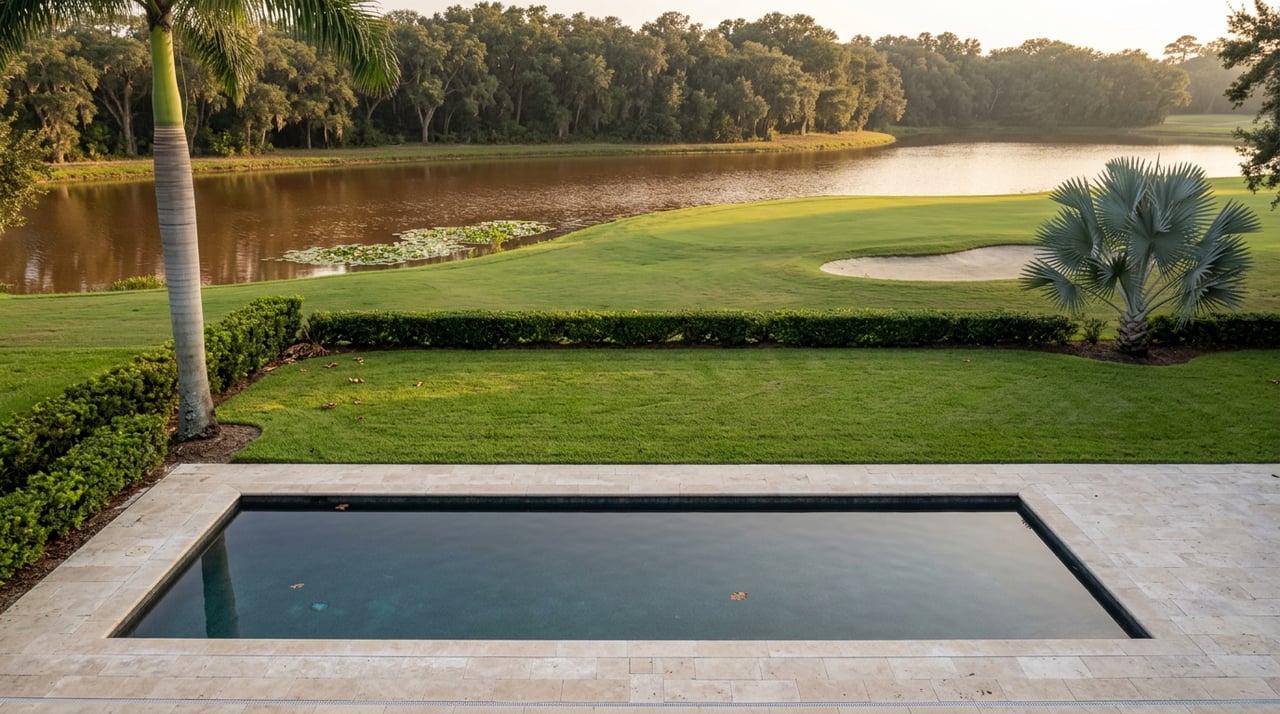
Tour Frenchman's Creek this month and you'll pass a fenced-off driving range, a reshaped ninth hole with exposed irrigation pipe, and enough heavy equipment staged near the clubhouse to make a first-time visitor wonder if they've arrived at the wrong moment. It's a fair question. Most buyers read active construction at a private club as a red flag, something to wait out until the dust settles and the amenities look finished again.
That reading gets the story backward. What's happening at Frenchman's Creek right now is less a warning than a reason to look closely at how the club plans and funds its capital improvements. That context can help buyers assess the club beyond what any finished photo of the ninth green can show.
The Project Behind the Fencing
According to Club & Resort Business and Golf Course Industry, the club broke ground this summer on a renovation of its driving range, short-game area, and the signature ninth hole on the South Course, with completion targeted for late October to early November, ahead of the winter season. The scope is specific: a full driving range overhaul that trades the old elevated tee for a traditional tee line with a dedicated iron area, a relocated and expanded short-game and putting complex next to the first tees, and a reimagined ninth hole that also expands the club's irrigation pond capacity. The work is led by golf course architecture firm Fry/Straka, with construction managed by NMP and support from Flynn Engineering, A Cut Above Landscaping, TCI-Rood Irrigation, and several other named contractors.
Club president Alan Gurock called it a chapter that demonstrates member commitment to continually enhancing the experience, and general manager and COO Rob Oosterhuis has been direct about the underlying driver: infrastructure that's more than twenty years old eventually needs to be rebuilt, not patched. Director of Golf JR Congdon has also pointed to a shift in how members actually use the facility, noting that practicing has become as social an activity as playing full rounds, which is part of why the short-game area is being pulled closer to the first tees rather than left where it was.
None of that reads like crisis management. It reads like a club executing a plan.
Where the Money Actually Comes From
Here's the part that matters more to a buyer than the sod being replaced. Frenchman's Creek operates as an equity-membership club, which means residency requires membership, and membership requires an equity fee paid at the time of purchase. That fee includes a contribution to the club's Capital Reserve Fund, on top of annual club dues and property owners' association fees set through the club's regular operating budget.
The club's equity structure includes a Capital Reserve Fund. Other club communities may use different funding approaches for large capital projects.
The club completed a $74 million, 124,450-square-foot clubhouse, designed by Peacock + Lewis, and moved into a separate multimillion-dollar golf course renovation with little gap between the two. The clubhouse project was approved by members in 2022, broke ground that year, and was completed by 2025. The current course renovation, a $10.48 million capital improvement, started barely a year later.
What a 75-Year-Old Average Membership Has to Do With Any of This
One detail from the club's own leadership is worth sitting with. The average age of Frenchman's Creek's 606 members is around 75. William Schmit, the club's Director of Agronomy, noted that the old elevated driving range tee required climbing stairs, which had become a genuine barrier for a meaningful share of the membership. The redesign brings the tee down to grade specifically to solve that.
That's not a cosmetic upgrade. That change makes the practice area easier to use for members who found the stairs difficult. For someone evaluating whether a club community will still feel current in a decade, that's a more useful signal than the clubhouse's dining venue count. For a buyer, the accessibility and practice-area updates offer one indication of how the club is adapting its facilities.
What This Means for the Number on the Listing Sheet
As of June 2026, the median sale price in Frenchman's Creek stood at $1,575,000, up 6% from the year before, with homes spending an average of 73 days on market, compared with a national average of 58 days. On paper, that combination looks like a market that's both expensive and slow.
Read against everything above, it looks more like a market that prices patience correctly. A 73-day average in a 606-home, low-density community with limited turnover isn't a sign of weak demand. It's the natural pace of a market where buyers are underwriting more than square footage, they're also considering a club undertaking capital projects, maintaining its infrastructure, and adapting its amenities as its membership ages. That kind of stability tends to support price appreciation even when the sales pace looks unhurried next to a typical single-family subdivision.
If you're cross-shopping nearby club communities, it's worth comparing that funding model directly. Frenchman's Reserve, just up the road, runs its own equity structure with a separate annual capital charge schedule for members, and the two clubs are worth lining up side by side rather than assuming all Palm Beach Gardens country club memberships work the same way.
Questions Worth Asking on Your Tour
If you're touring Frenchman's Creek while the course work is underway, a few questions will tell you more than the construction fencing ever will:
- What is the current balance and target level for the Capital Reserve Fund, and how did this project draw against it?
- Is any additional capital charge anticipated once the current renovation wraps, or does the equity fee structure cover it in full?
- What access will members have to the South Course and practice facilities during the final weeks of construction, and has that timeline slipped from the original fall target?
- How does the equity fee and annual capital dues schedule compare to what you'd pay at a similarly positioned club nearby?
Asking these before you write an offer tells you whether you're buying into a club with a funding cushion or one leaning on its next buyer's equity fee to finish the job.
A Few Questions Buyers Often Ask
Will the golf course be playable while I'm considering a home here? Parts of the driving range and the South Course's ninth hole are closed during active construction, with the club targeting completion in late October or early November 2026. If golf access matters to your timeline, ask the listing team for the current status before scheduling a tour focused on the course.
Does my equity fee change depending on when I buy relative to a capital project? The equity fee and its contribution to the Capital Reserve Fund are set by the club's membership plan and annual operating budget, not by which capital project happens to be underway when you close. Review the current Membership Documents directly rather than relying on secondhand estimates.
Is a slower average time on market a sign of soft demand? Not necessarily. In a small, low-turnover community like Frenchman's Creek, a longer average days-on-market figure often reflects a limited pool of comparable listings and buyers who take their time, not weak buyer interest.
If you're weighing Frenchman's Creek against other Palm Beach Gardens club communities, or trying to read what an ongoing capital project actually means for your offer strategy, Chris Moody can walk through the specifics with you directly. Let's achieve your real estate goals.
This article is general information, not legal, tax or financial advice. Consult a qualified professional about your situation.